
I am currently an Associate Researcher at the School of Computer Science and Technology, Hangzhou Dianzi University.
I received my Ph.D. degree in Information and Communication Engineering from the College of Information Science and Electronic Engineering, Zhejiang University in 2025. During my doctoral studies, I worked in the Machine Vision and Navigation Laboratory (机器视觉与导航实验室) led by Prof. Zhiyu Xiang (项志宇), under the supervision of Assoc. Prof. Xiaojin Gong (龚小谨).
My current research interests include computer vision, anomaly detection, and multimodal LLMs.
🔥 News
- 2026.03: 🎉 Our paper about Enhancing Weakly Supervised Multimodal Video Anomaly Detection through Text Guidance has been accepted to IEEE Transactions on Multimedia (IF=9.7).
- 2025.02: 🎉 Our paper about Delving into Instance Modeling for Weakly Supervised Video Anomaly Detection has been accepted to IEEE Transactions on Circuits and Systems for Video Technology (IF=8.3).
- 2024.07: 🎉 Our paper about Text-Driven Scene-Decoupled (TDSD) Weakly Supervised Video Anomaly Detection has been accepted to ACM Multimedia (MM) 2024.
- 2024.07: 🎉 Our paper about Event-Driven Weakly Supervised Video Anomaly Detection has been accepted to Image and Vision Computing.
- 2024.05: We release the code of Multi-scale Bottleneck Transformer (MSBT), we encourage you to integrate the MSBT module into your framework to enhance the performance of feature fusion.
- 2024.03: 🎉 Our paper about MultiScale Bottleneck Transformer (MSBT) has been accepted to IEEE International Conference on Multimedia and Expo (ICME) 2024.
- 2023.03: 🎉 Our paper about Long-Short Temporal Co-Teaching (LSTC) for Weakly Supervised Video Anomaly Detection has been accepted to IEEE International Conference on Multimedia and Expo (ICME) 2023.
- 2023.02: 🎉 Our paper about Hierarchical Semantic Contrast (HSC) for Scene-Aware Video Anomaly Detection has been accepted to IEEE/CVF Conference on Computer Vision and Pattern Recognition (CVPR) 2023.
📝 Publications
🏹 Selected Projects
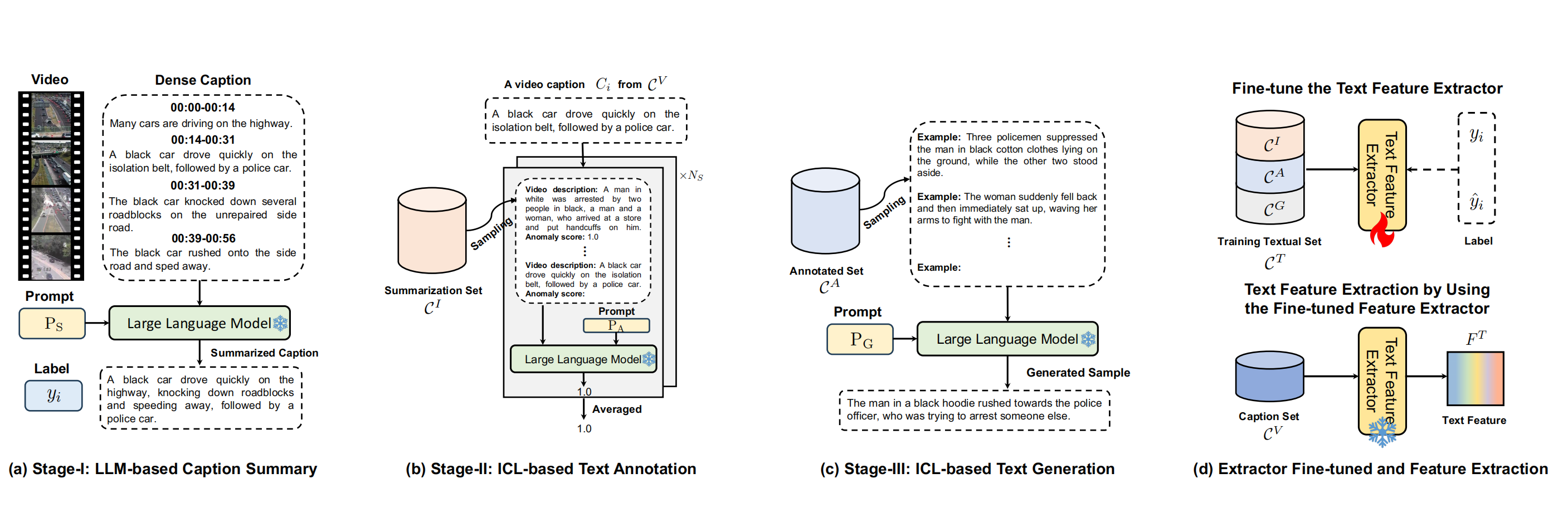
Enhancing Weakly Supervised Multimodal Video Anomaly Detection through Text Guidance
Shengyang Sun, Jiashen Hua, Junyi Feng, Xiaojin Gong
- TGMVAD is the first work to employ in-context learning (ICL) to the task of weakly-supervised multimodal video anomaly detection for the purpose of augmenting text samples.
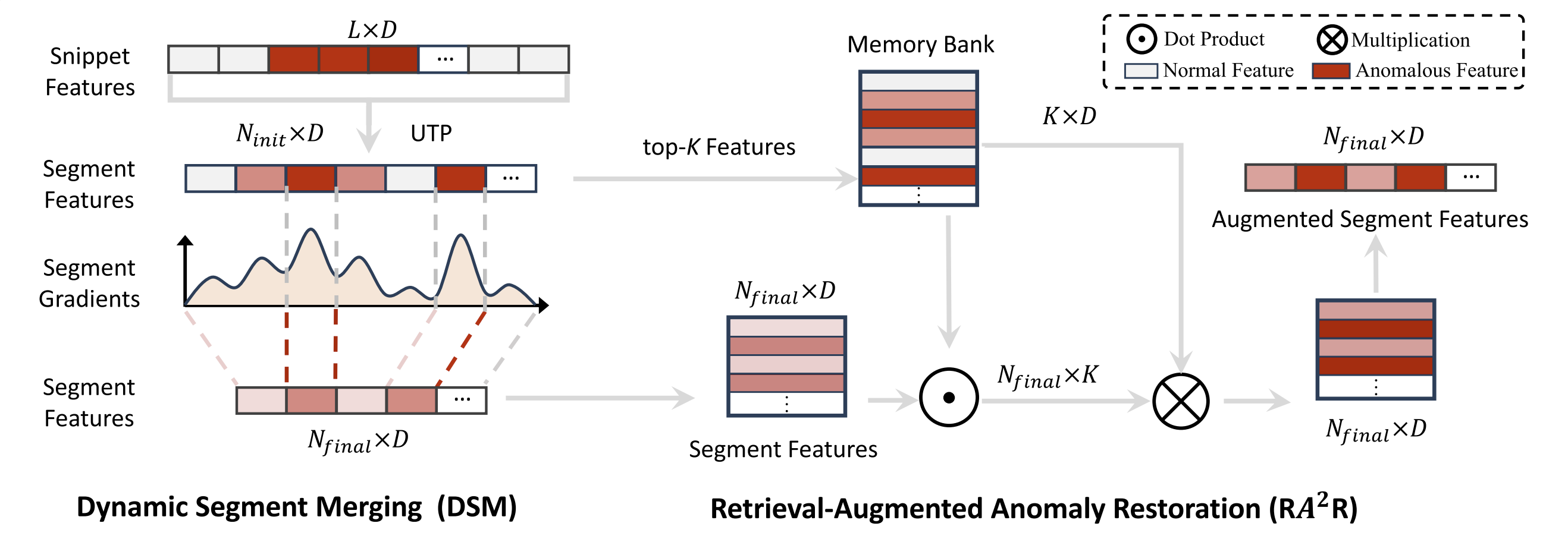
Delving Into Instance Modeling for Weakly Supervised Video Anomaly Detection
Shengyang Sun, Jiashen Hua, Junyi Feng, Dongxu Wei, Baisheng Lai, Xiaojin Gong
- This is the first work to our knowledge that deliberately explores the issue of anomaly contamination and dilution along the temporal dimension, which is overlooked by prior MIL-based weakly-supervised video anomaly detection works.
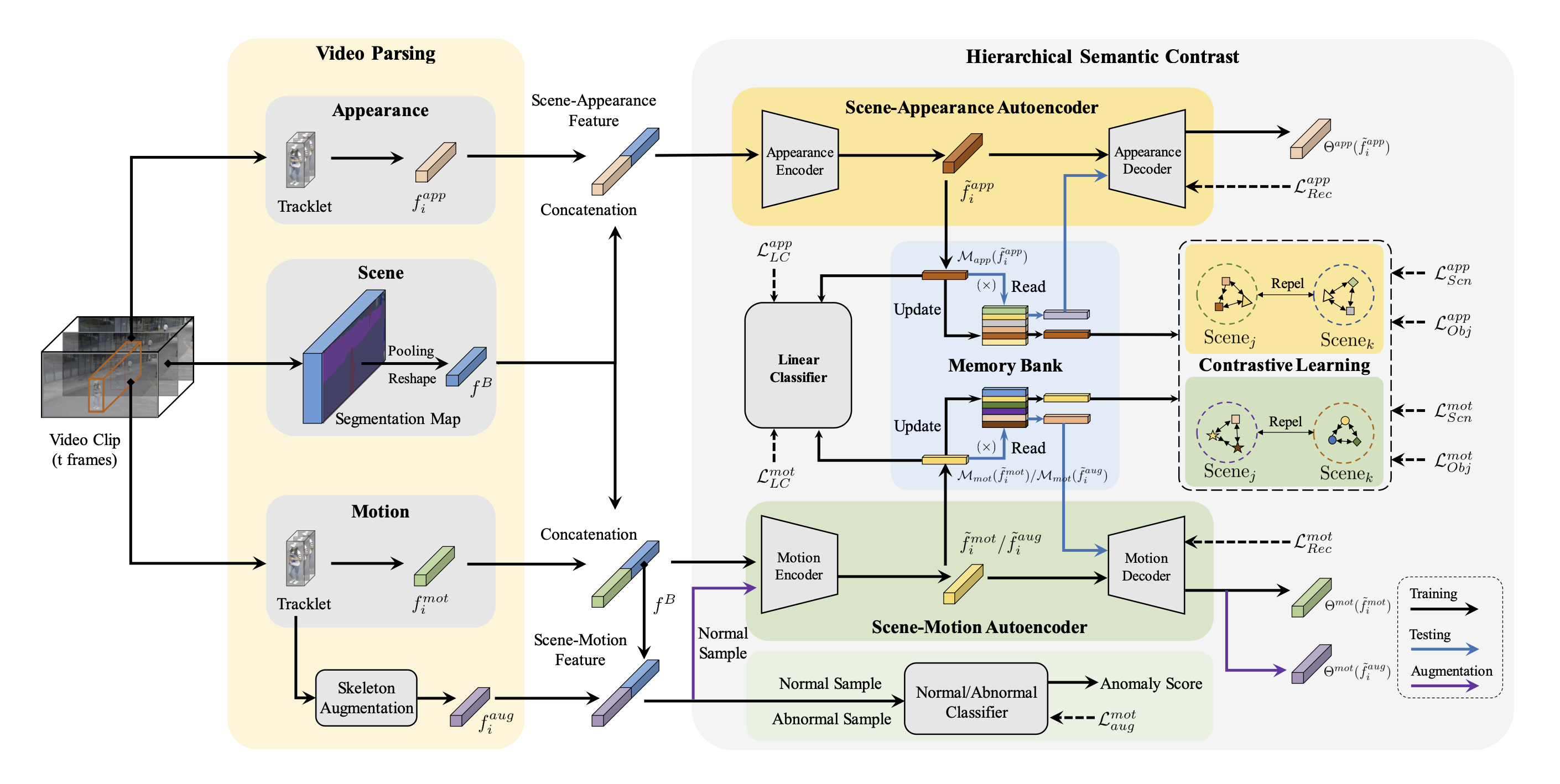
Hierarchical semantic contrast for scene-aware video anomaly detection
Shengyang Sun, Xiaojin Gong
- We build a scene-aware reconstruction framework composed of scene-aware feature encoders and objectcentric feature decoders for anomaly detection.
- We propose hierarchical semantic contrastive learning to regularize the encoded features in the latent spaces, making normal features more compact within the same semantic classes and separable between different classes.
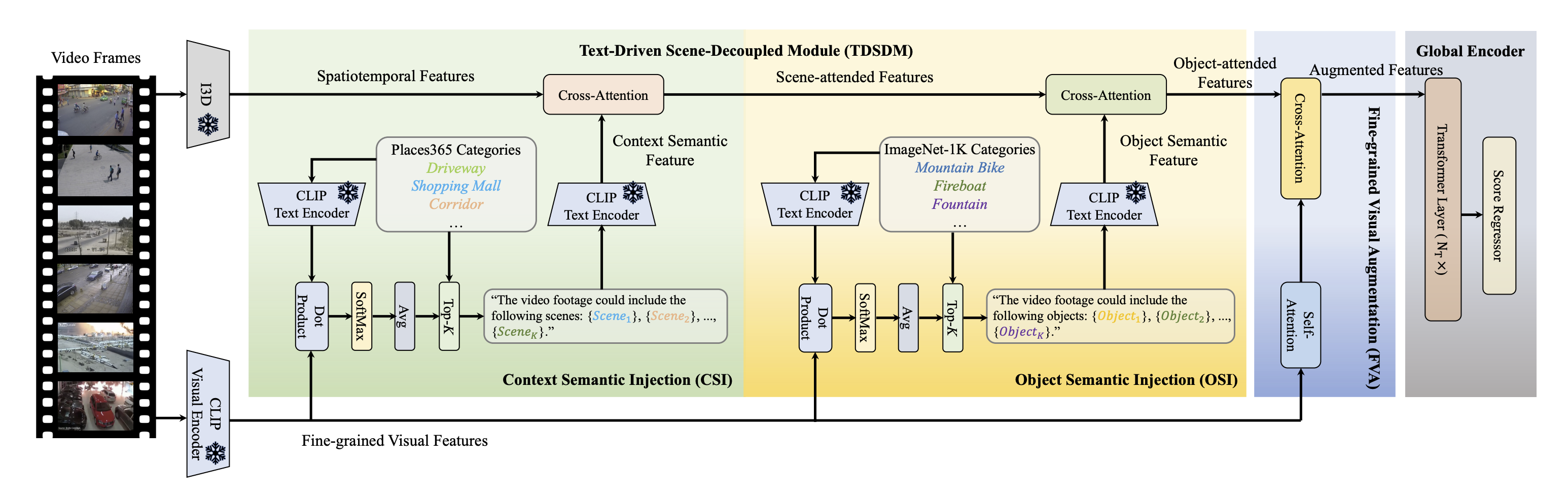
TDSD: Text-Driven Scene-Decoupled Weakly Supervised Video Anomaly Detection
Shengyang Sun, Jiashen Hua, Junyi Feng, Dongxu Wei, Baisheng Lai, Xiaojin Gong
- This is the first work to address scene-dependent video anomaly detection under a weakly supervised setting.
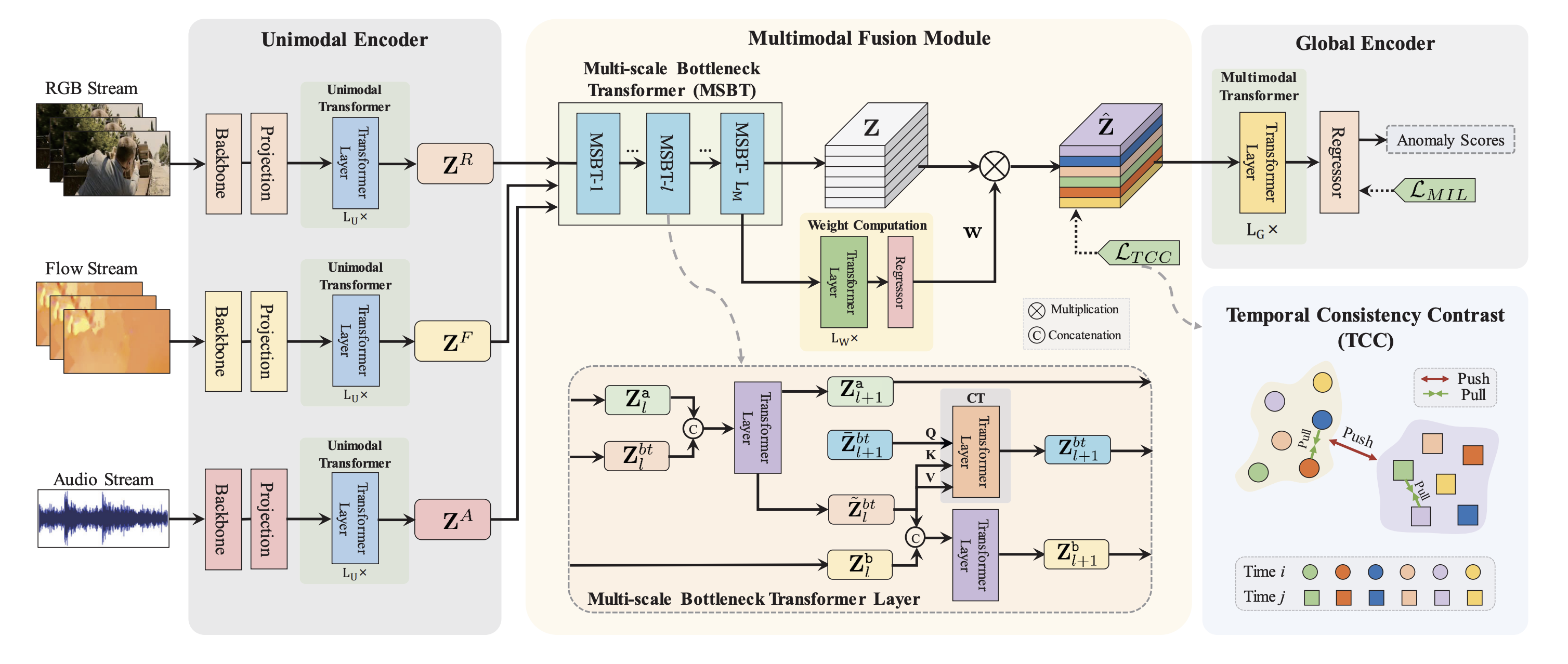
Multi-scale Bottleneck Transformer for Weakly Supervised Multimodal Violence Detection
Shengyang Sun, Xiaojin Gong
- We propose a multi-scale bottleneck transformer (MSBT)-based fusion module. It leverages a reduced number of bottleneck tokens to transmit gradually condensed information from one modality to another and a bottleneck token-based weighting scheme to weight the fused features, effectively addressing the information redundancy and modality imbalance problems.
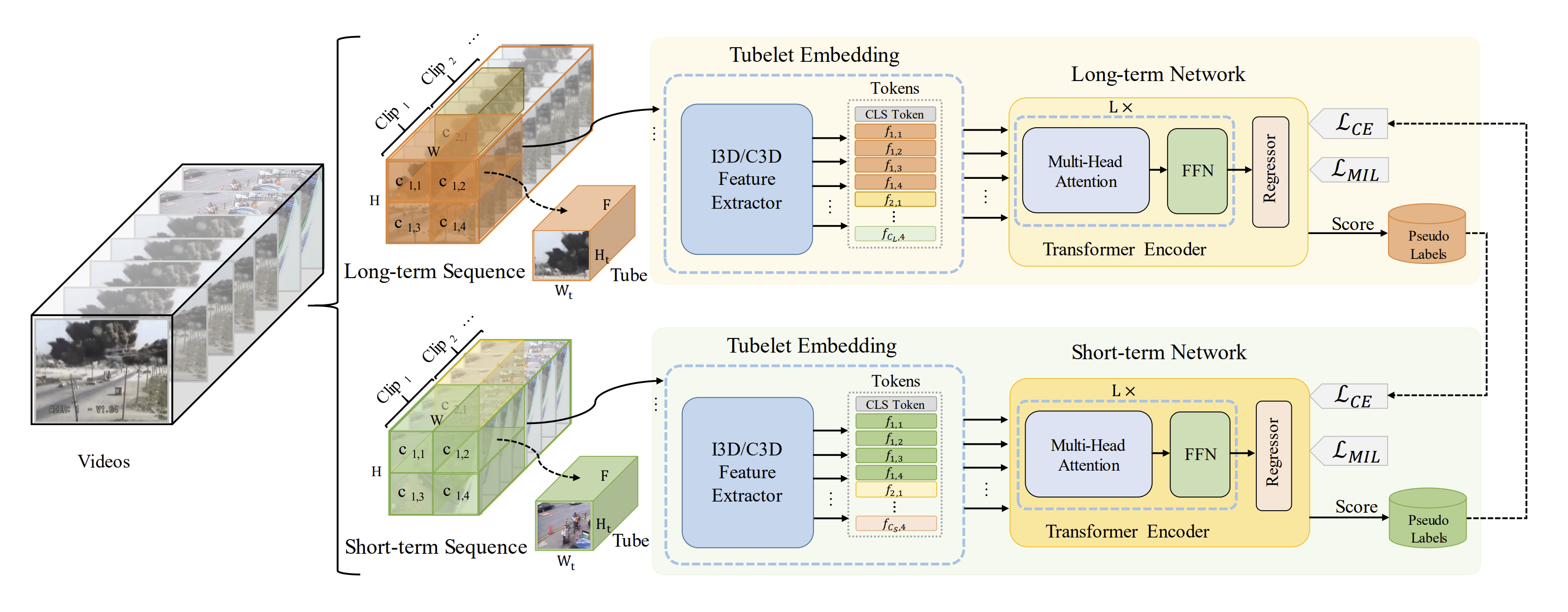
Long-Short Temporal Co-Teaching for Weakly Supervised Video Anomaly Detection
Shengyang Sun, Xiaojin Gong
- We employ a co-teaching strategy to train short- and long-term networks alternatively and iteratively. The two networks can explicitly learn from abnormal events with varying durations.
🌟 Latest Works
TMM 2026Enhancing Weakly Supervised Multimodal Video Anomaly Detection through Text Guidance, Shengyang Sun, Jiashen Hua, Junyi Feng, Xiaojin GongTCSVT 2025Delving Into Instance Modeling for Weakly Supervised Video Anomaly Detection, Shengyang Sun, Jiashen Hua, Junyi Feng, Dongxu Wei, Baisheng Lai, Xiaojin GongACM MM 2024TDSD: Text-Driven Scene-Decoupled Weakly Supervised Video Anomaly Detection, Shengyang Sun, Jiashen Hua, Junyi Feng, Dongxu Wei, Baisheng Lai, Xiaojin GongIVC 2024Event-Driven Weakly Supervised Video Anomaly Detection, Shengyang Sun, Xiaojin GongICME 2024Multi-scale Bottleneck Transformer for Weakly Supervised Multimodal Violence Detection, Shengyang Sun, Xiaojin GongCVPR 2023Hierarchical semantic contrast for scene-aware video anomaly detection, Shengyang Sun, Xiaojin GongICME 2023Long-Short Temporal Co-Teaching for Weakly Supervised Video Anomaly Detection, Shengyang Sun, Xiaojin GongTCDS 2021In Situ Learning in Hardware Compatible Multilayer Memristive Spiking Neural Network, Jiwei Li, Hui Xu, Shengyang Sun, et al.NEUROCOM 2021In-situ Learning in Multilayer Locally-connected Memristive Spiking Neural Network, Jiwei Li, Hui Xu, Shengyang Sun, et al.TCS 2020Binary Memristive Synapse based Vector Neural Network Architecture and its Application, Haijun Liu, Shengyang Sun, et al.NEUROCOM 2020Enhanced Spiking Neural Network with Forgetting Phenomenon based on Electronic Synaptic Devices, Jiwei Li, Hui Xu, Shengyang Sun, et al.Chinese Physics B 2020Memristor-based vector neural network architecture, Haijun Liu, Changlin Chen, Xi Zhu, Shengyang Sun, et al.IJCNN 2019Cascaded neural network for memristor based neuromorphic computing, Shengyang Sun, et al.IJCNN 2018Low-consumption neuromorphic memristor architecture based on convolutional neural networks, Shengyang Sun, et al.
📖 Educations
- 2021.09 - 2025.03, Zhejiang University, Ph.D., Information and Communication Engineering
- 2017.09 - 2021.06, National University of Defense Technology, M.E., Electronic Engineering
- 2013.09 - 2017.06, National University of Defense Technology, B.S., Information Engineering
💬 Invited Talks
- 2025.03, Lectures of Academic Climbing Program,Hangzhou Dianzi University, Hangzhou, China
- 2021.12, The 91st Academic Forum of the College of Information Science and Electronic Engineering, Zhejiang University, Hangzhou, China